Back in 1983, I remember the start of an organisation called Common Ground. Founded by Sue Clifford, Angela King and Richard Deakin, this small, non-political group made 'Local Distinctiveness' its core raison d'être. From small beginnings, many initiatives and projects grew, run by local people with support and input from Common Ground. You may well have heard of some of these projects.
Between 1986 and 1988, Dorset communities and individuals, with input from Common Ground, commissioned new sculptures for the local landscape. The thinking behind the New Milestones project was to explore 'what places mean to the people who live in them, and… how to express that meaning in an imaginative and accessible way through sculpture' (New Milestones: Sculpture, Community and the Land, 1988, p. 15, Joanna Morland).
The five Dorset sculptures were created by Christine Angus, Andy Goldsworthy, John Maine, Peter Randall-Page and Simon Thomas. The project was subsequently extended to Yorkshire, where Alain Ayers and Richard Farrington created a further series of sculptures. Michael Fairfax produced the project's final sculpture commission in Somerset, located at Waterrow.
This project sparked interest in people's local places and, together with Common Ground's publication Holding Your Ground: An Action Guide to Local Conservation, gave rise to another Common Ground initiative: the Parish Maps Project. This incredibly successful project saw thousands of communities across the UK take part. Many communities in Europe and the USA also adopted the concept.
Today, these projects remind us of the importance of local identity and community involvement. They also resonate with the ethos behind my Rooted & Rural project, which aims to foster a deeper connection to a sense of place, to people and to a more thoughtful, responsible way of living.
Apples, Orchards and Memories
Alongside Parish Maps, Apple Day was another of Common Ground's most successful projects. Apple Day is now a national day and falls on 21 October. In practice, it has become Apple Month by default, with celebrations encompassing the diversity of apples and orchards within their localities.
I believe Apple Day is now an important part of our heritage, both locally and nationally. It highlighted the fact that many old varieties were in danger of being lost. For some, it was too late, but many old orchards have been saved and old varieties rediscovered.
As a child, I remember one highlight of Christmas preparations: my father coming home with two large boxes of Cox's Orange Pippin apples. I can see them now, beautifully wrapped individually in white tissue paper and packed snugly in wooden apple crates. We'd store these in one of the outside sheds, and the fruit bowl on the long mahogany sideboard in the dining room would be replenished regularly during the Christmas holidays.
A Cox's Pippin has a unique taste. As today's 'influencers' might say, it's aromatically rich, with an indefinable sweet but slightly spicy flavour… and very yummy (they wouldn't say that bit!). However, although it's no longer as readily available, this variety is still regarded by connoisseurs and those in the know as the ultimate traditional British heritage eating apple.
Tastes have apparently changed, and consumers now demand apples of the same shape and size all year round. I would suggest, however, that this demand is not led entirely by consumers but by the industrial food chain, which has the buying power to insist that growers produce only those apples which, with the help of practices such as controlled-atmosphere storage, can be kept for six to twelve months at lowered oxygen levels and still retain their crunch when they eventually make it to supermarket shelves.
For some strange reason, some - probably the vast majority of - consumers now expect to buy fresh apples in spring and summer, even though the apple harvest is an autumnal event. It is a bit like expecting to eat strawberries in December, or in any other month outside their season, which generally runs from late May to early September. Again, this need for year-round access to produce could be driven by the marketing power of Big Food and retail gatekeepers rather than by consumers.
Perhaps, though, we can start to buck this trend, reconnect, eat with the seasons and support local producers whenever possible! (End of rant!)
The UK apparently has 6,000 varieties recorded in the National Apple Register, but commercial orchards seem to be dominated by only a dozen or so varieties. Apple Day has raised awareness, reignited interest and educated people about what our heritage cultivars offer, benefiting growers, cider makers, farmers, chefs and, ultimately, the public.
Traditional orchards are also mini-ecosystems which provide year-round support for a wide variety of wildlife. Overall, the South West has lost between 74% and 80% of its traditional orchards since 1900. In the last 50 years alone, Somerset has lost 50%, and Devon has lost 90% since the Second World War. The steepest declines followed the Second World War across the board, due to post-war neglect, urban development and agricultural intensification.
A Westcountry Apple Heritage
The names of some of the old varieties are interesting, such as Foxwhelp, recorded in the Forest of Dean in 1653, or possibly earlier; Bridgewater Pippin, mentioned in 1665; Pig's Nose, found on the Devon/Cornish border; and Slack-ma-Girdle, grown across the West Country and first noted in Devon in the early 18th century. Quite a few indicate the geographical origin of the variety: Yarlington Mill, Stembridge Jersey and Curry Codling (Rivel, North or Mallet - take your pick as to which Curry!). We also have 'the Toms' - Harvey, Putt, Legg and McCormick.
The Humble Crab Apple
Then we come to the crab apple (Malus sylvestris). This is the only truly indigenous apple tree in this country, and archaeological research shows that people ate it in Neolithic times. When the Romans invaded and introduced sweet apples to this country, cross-pollination with the native crab apple was inevitable. The Middle English word 'crab' means sour or bitter, so this likely gave the apple its name.
Deeply rooted in our heritage and mythology, apples were often associated with the 'Otherworld' and immortality, as in the stories of Avalon, or 'The Isle of Apples'. As our native species, the crab apple would have been very familiar to the early inhabitants of these islands.
Crab apple trees often grow in or near orchards, which is highly beneficial because their extended flowering period, from early April to late May, produces abundant pollen and makes them a magnet for pollinators. This is a good thing and has many benefits. These pollinators move most of the heavy, sticky pollen between trees rather than relying on the wind to carry it. Because the pollen isn't carried through the air in large amounts, it poses a low allergen risk.
The crab apple tree also benefits a variety of wildlife species by providing a habitat for a wide range of invertebrates. Its early flowers provide a food source for bumblebees, honeybees, solitary bees, hoverflies and butterflies. At the same time, moth and butterfly larvae feed on the foliage as they develop into numerous species of caterpillars, while ladybird and hoverfly larvae feed on sap-sucking aphids, which gorge themselves on young apple shoots.
Then there are the many common birds attracted to the fallen fruit and the invertebrates which frequent the trees - robins, thrushes, greenfinches, starlings and blackbirds. It is also known that some territorial birds, such as pheasants and mistle thrushes, defend a particular tree against other birds. Because apples often cling to the branches well into the cold, dark days of winter, they are a crucial food source for small woodland animals such as voles and mice, and for the not-so-small, such as badgers and foxes, which feed on the fallen fruit.
During the medieval period, people used crab apples for food, cider production and medicine. Their high pectin content made them useful for producing verjuice, a sour juice used in cooking and preserving, similar to vinegar. The juice was revered by apothecaries for its healing qualities and was used to treat and clean wounds. In John Gerard's Herbal of 1597, it is noted that:
"The juice of wild apple crabs taketh away the heat of burnings, scaldings and all inflammations; and being laid on for a short time after it is scalded, it keepeth from blistering".
The crab apple also appears in the Anglo-Saxon Nine Herbs Charm, written in the 10th century and surviving as part of the Lacnunga, meaning 'Remedies'. A manuscript of it survives in the British Library.
Often overlooked, unidentified or dismissed because its fruit is sour, the crab apple tree can easily blend into the background when it is not in flower, whether in a field hedge or on the edge of a woodland. Yet our only indigenous apple tree still has so much to offer us and the wildlife that surrounds us.
So, next time you think of planting a tree, remember what Cecily M. Baker wrote in her book Flower Fairies of the Spring:
"Crab-apples, Crab-apples, out in the wood,
Little and bitter, yet little and good!"
Oh, yes… and I forgot to mention that if you happen to be wandering through an orchard in that very early morning light, where the mist seems to take on a silver sheen, as it does just before the human world wakes, do not be surprised if you think you catch a glimpse of unicorns grazing quietly under the apple trees… because, as we all know - this is where unicorns are known to graze from September to May….
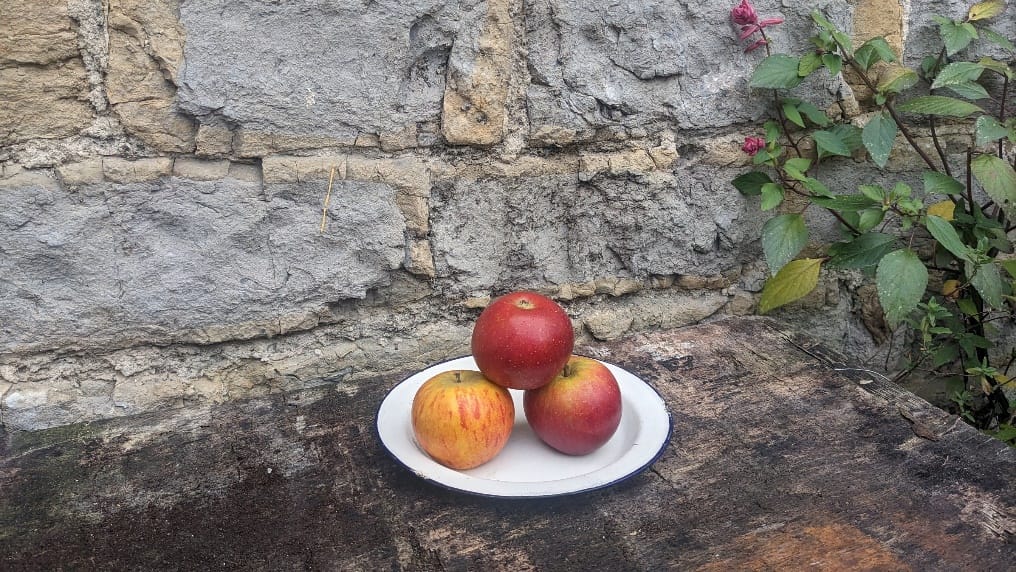
Grown in Somerset